The Popliteus and the Driver
I didn't know I had a popliteus until my knee filed a complaint. Then Texas wind asked for power I couldn't pay for—and my driver became a polite suggestion.

I am fifty-one years old. I have flirted with being athletic my whole life—usually in chapters. Running. Lifting. Cycling. Mountain biking. Baseball years where I threw hours of BP and hit fungos until my body reminded me I was not twenty anymore. Golf. And all the messy overlap in between.
I know my way around a gym. That does not mean I was preparing like a golfer.
And I had no idea what a popliteus was.
If you had asked me to guess, I would have said it was either a minor Roman senator or a lost interlude on Primus’ Sailing the Seas of Cheese—the kind of moment where the room decides whether to commit to the weird—or some screamy death-metal opener with an illegible logo and a name that sounds like a medical procedure gone wrong. I would not have said: small muscle, back of the knee, surprisingly opinionated.
But the body teaches on its own schedule. My syllabus arrived behind my knee after a round—especially on days when I was trying to squeeze a little extra out of the driver. Not a dramatic injury story. More like a slow accusation from anatomy.
TPC Craig Ranch does not care about your feelings
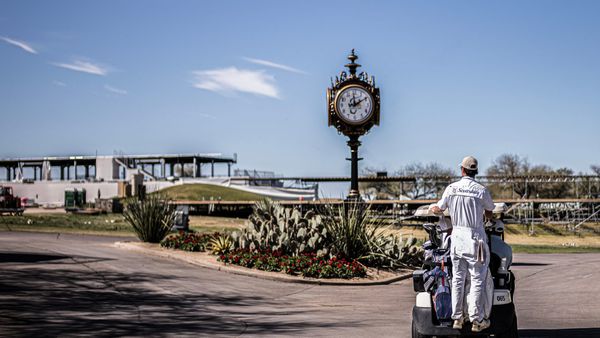
A few months back I played a round in Dallas at TPC Craig Ranch.
It is a serious golf course—redesigned, hard, the kind of place that reminds you the tour is not a personality contest. It is also the kind of course where you feel honored to be there and slightly judged by every lie.
The greens look less like traditional putting surfaces and more like a motocross track, a pool table, and a skate park were forced to do a group project—beautiful turf, criminal contour, and a quiet refusal to let you feel smart.
In 2025, Scottie Scheffler won the Byron Nelson here at 31 under par—he did not negotiate with the golf course, he ran it over. That score tied the PGA Tour record for lowest 72-hole total. After that kind of week, TPC Craig Ranch got redesigned. The greens, the defenses, the whole exam—it got harder. That is not locker-room mythology. It is what happened.
They play the Byron Nelson here again next month. When you see them on this property, you will see what I mean—the numbers will not look like thirty-one under. Not because the players forgot how to play, but because the exam got harder. Call it a benign prediction.
The course was in great shape when I played it.
Then the Texas wind showed up.
I am not going to romanticize wind. Wind is not a metaphor. Wind is an accountant. It asks for ball flight you do not have, then it adds interest.
And if you are leaving the face open, creating massive spin, and launching a driver higher than it has any right to be—more wedge balloon than boring, penetrating driver—wind stops being weather and becomes a debt collector. You are not negotiating. You are just watching the ball do improv.
By the fifteenth hole, my knee was not “tight.” It was loud.
That is a miserable kind of cognitive dissonance. You are standing on property connected to the Byron Nelson. You paid for the experience. You want to remember the shots, the lines, the greens.
Instead you remember trying to manufacture power with a body that was running out of places to borrow from.
I think I shot about 115 that day. I am not asking for sympathy. I am asking for context.
What was actually happening (the grown-up version)
I have been working on hip internal rotation. That sounds like a humble little detail—like something you fix with a stretch and a good attitude.
In reality, it changes how your body can rotate and accept force. When one part of the chain opens up, the rest of the system does not always celebrate politely. Sometimes it reorganizes. Sometimes it sends the bill somewhere else.
I also have ankle mobility—or, more honestly, a lack of it—that has to be accounted for. Ankle limitations have a special talent: they encourage the knee to become creative.
None of this is moral. It is not “weakness.” It is distribution.
When you add fatigue, a hard course, extra intent into the wind, and a swing that is already asking for more than you have on credit, the knee can end up holding torque like the last person at the party stuck cleaning up.
The popliteus—now that I have been introduced—is part of that posterior-knee neighborhood that helps manage rotation and control as the joint is asked to do golf things under load.
You can call it an emergency brake if you want a mental picture. I do. Just don’t confuse the metaphor with villainy. The muscle isn’t “bad.” It’s the place the bill showed up.
There is a Titleist Performance Institute way of saying what I was learning the painful way: if you are serious about improving, you stop treating the game like a single problem you can solve with a swing thought and a bucket of balls. You look at the complete picture—and you get honest about your limitations. Not performatively honest. Practically honest. The kind that changes what you do on Tuesday, not what you post about on Saturday.
The humble realization is not melodrama. It is worse than melodrama, because it is boring: your body will not move the way you need it to—not under fatigue, not in the wind, not when the course asks for more than you have on credit—until you stop treating that fact like a personal insult and start treating it like information.
I know my way around a gym. I was still training for the wrong movie.
Here is an uncomfortable truth I can laugh at now: for a long time I trained more like a football player than a golfer.
That is not a flex. Football-adjacent training can make you strong in ways that matter. It can also make you strong in the wrong rooms for golf—too much sagittal drama, not enough rotation literacy, not enough “can you brace, turn, and pay for speed without turning into a pretzel under fatigue.”
So I rebuilt the week.
Three days of strength work. Not chaos—structure. Posterior chain work that reminds your body you are supposed to be athletic all the way down the back side. Carries that make your grip and your midsection stop lying to each other. Romanian deadlifts that announce, calmly, that you are not allowed to pretend your hamstrings are “fine.”
Alongside that: golf-related mobility that looks insultingly simple until twenty-four hours later, when you realize your core has been coasting for a decade.
If you have ever done a Pallof press from a tall kneeling or half-kneeling position, you know the vibe. It looks like nothing. It feels like a personality audit.
The warm-up I actually deserved
There is one more piece I did not fully respect until recently: the warm-up.
For years, if I am honest, my warm-up was two knee bends and a few half-hearted practice swings—and then I walked to the first tee like I had earned the right to be athletic.
I had not.
Now I treat warm-up like it matters: enough to get my glutes firing and my hamstrings online before I ask them to stabilize a swing and survive a walking day. At fifty-one, with an office-shaped job, I do not get to skip that step and expect my body to forgive me on the back nine.
The first tee is not your warm-up. A small bucket on the range is not a substitute for hips that spent the week in a chair. If you want rotation and speed when it counts, you have to invest before the round, quietly and without applause—or your body will collect the debt later, usually on a hole with wind and pride.
The driver had gone on strike
I am not a long driver. I have never been the guy who makes people step back on the tee box for safety reasons.
But I know my numbers well enough to know when something is wrong.
What used to be about a two-forty drive had turned into something closer to two-oh-five. That is not a statistical quirk. That is a different sport.
At Craig Ranch, I wasn’t just short. I was trying to buy distance with effort—and the swing paid for it in the worst currency: spin and a face that wouldn’t behave.
I was getting under it. Too much spin. A ball flight that was doing that insecure thing where it can’t decide if it’s a fade or a slice, so it tries both and picks the worse one.
None of that is shameful. It is what happens when capacity drops and intent rises. The swing doesn’t become “bad” first. It becomes expensive.
Week four is when the body stops rolling its eyes at you
After about four weeks of doing the boring work consistently, something changed.
My driver came back.
I am not going to pretend I can isolate variables like a lab. I made swing corrections too. I was stronger at address. I wasn’t leaking the face the same way. My body wasn’t forcing the emergency brake on every hard swing.
And yes—I am aware Arizona ground is starting to firm up as it heats up, and firm turf tends to give you more release—more roll—once the ball lands. We will absolutely not factor that in, except to say I am capable of loving free distance as much as the next golfer, and I still have dignity. Mostly.
The point is not that weight training is magic.
The point is that getting better at golf is not a single department.
It is not “just the swing.”
It is not “just short game.”
It is not “just putting.”
It is everything—including the body that has to fund the swing you keep asking for, especially on the back nine when you are tired and the wind is doing accounting in your face.
The honest close
If your body is setting your limitations, you can yell swing thoughts at it all day. You can buy equipment. You can watch videos until your phone overheats.
You can also do what I did first—go play a hard golf course and try to fix yourself on the fly—which is a very efficient way to learn humility.
What I should have done earlier—and what I did eventually—was get evaluated by someone who actually maps movement for a living. I went to a Titleist Performance Institute mobility expert, did a full evaluation, and walked out with a clear picture of what my body was doing and what it was not willing to pretend about anymore. If you are guessing your way through pain and compensation, go get evaluated. It is the unglamorous thing that saves you from heroics on the course.
Then you do the rest like an adult: improve what can be improved, and stop asking your knee to be the last line of defense for torque you were never supposed to store there.
I still can’t spell popliteus on the first try.
But I know what it feels like when the bill comes due—and I’d rather pay upstream, in the gym and in mobility work, than on hole fifteen, in Texas, with pride on the line and the wind asking questions I can’t answer.