Why Golf Improvement Is a Learning Problem, Not a Swing Problem
Most golfers don’t struggle because they lack effort or instruction — they struggle because their improvement process ignores how learning actually works. Golf improvement isn’t a swing problem. It’s a learning problem.
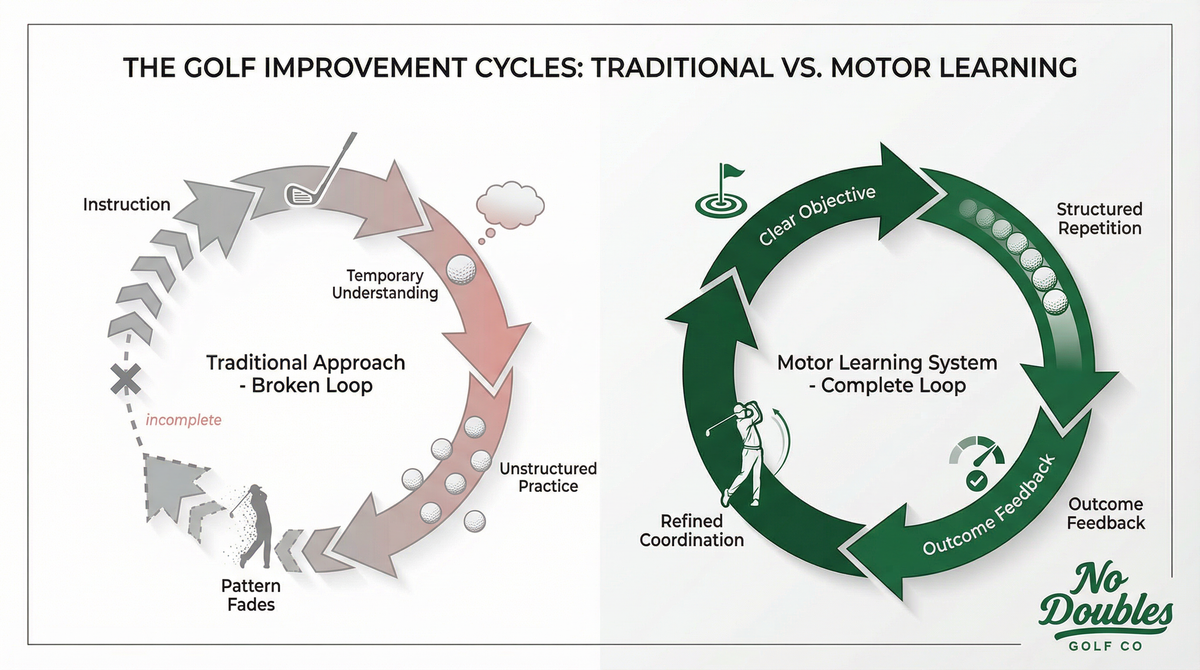
Golf instruction hasn’t failed in three different ways.
It has failed in one way — repeatedly.
Over the last few posts, we’ve looked at why traditional lessons often don’t lead to lasting improvement, why YouTube tips and social media instruction make many golfers worse, and why thousands of hours of practice still leave players stuck at the same handicap.
Those aren’t separate problems.
They’re symptoms of the same underlying mistake.
The Pattern Hiding in Plain Sight
Most golfers try three main paths to get better:
- Lessons — explanations, demonstrations, expert feedback
- Tips — quick fixes, swing thoughts, online drills
- Practice — repetition, range sessions, “putting in the work”
On the surface, all three make sense. None of them are inherently bad.
And yet, for most amateur golfers, all three fail in the same ways:
- progress is temporary
- changes don’t hold up on the course
- confidence erodes instead of growing
That tells us something important.
The problem isn’t effort.
The problem isn’t access to information.
The problem isn’t even instruction quality.
The problem is that instruction is being mistaken for learning.
Instruction Is Not the Same Thing as Learning
Explaining a movement is not the same as teaching a skill.
You can understand what a good golf swing looks like and still be unable to produce one under pressure. You can repeat a swing thought perfectly on the range and lose it entirely on the course. You can even feel like you’re doing the “right” thing while your body keeps doing the old pattern.
That isn’t a lack of discipline or intelligence.
That’s how motor learning works.
Instruction deals in knowledge.
Learning deals in behavior change.
They are related — but they are not the same.
Why Golf Makes This Especially Difficult
Golf is uniquely unforgiving when it comes to learning.
- The swing happens too fast to consciously control
- Feedback is indirect and delayed
- Outcomes are noisy and inconsistent
In golf, you can do the wrong thing and still hit a decent shot.
And you can do the right thing and hit a terrible one.
That breaks the brain’s natural learning loop.
So golfers compensate by seeking more explanation, more tips, and more confirmation. It feels productive, but it often slows improvement instead of accelerating it.
How Humans Actually Learn Motor Skills
Skills are not learned by understanding them.
They are learned by adapting through repetition in a structured environment.
When the brain acquires a motor skill, it does so by:
- repeating actions with a clear objective
- receiving simple, outcome-based feedback
- gradually refining coordination without conscious micromanagement
Early learning works best when:
- focus is narrow
- tasks are consistent
- constraints guide movement
- feedback is limited
Too much information interferes.
Too many swing thoughts slow adaptation.
Too much conscious control prevents movements from stabilizing.
This isn’t unique to golf.
It’s how humans learn all complex physical skills.
Golf just exposes the failure faster.
Why Lessons, Tips, and Practice Fail in the Same Way
Once you understand learning, the earlier failures become obvious.
- Lessons fail because feedback is episodic. You improve briefly, then practice alone without structure.
- Tips fail because they compete with each other. The brain can’t stabilize a movement when the target keeps changing.
- Unguided practice fails because repetition doesn’t fix flaws — it reinforces whatever pattern already exists.
In every case, the system ignores how habits are actually formed.
That’s why changes disappear under pressure.
That’s why golfers can practice more and regress.
That’s why improvement feels fragile instead of earned.
This Is Not a Tip Problem — It’s a System Design Problem
Most golfers don’t fail because they lack motivation, time, or effort.
They fail because the systems they rely on to improve are not designed around how learning actually works.
Golf improvement requires a learning system, not a collection of advice.
A real learning system:
- defines what skill is being trained
- limits focus to prevent interference
- uses constraints instead of explanations
- sequences skills instead of stacking them
- controls when feedback appears — and when it disappears
- measures progress by stability and transfer, not how the swing looks
Most instruction doesn’t fail because it’s wrong.
It fails because it’s unstructured.
Without structure, even good advice becomes noise.
Why Most Golf “Programs” Still Miss This
Many modern tools promise better analysis, more personalization, or deeper insight.
But knowing what’s wrong doesn’t automatically tell you how to fix it.
Swing analysis without learning design becomes diagnosis without treatment.
Content libraries without progression become organized confusion.
Personalization without structure becomes noise — just tailored to you.
A learning system is not defined by how much information it contains, but by how carefully it controls what you practice, when you practice it, and why.
The Question Golfers Should Actually Be Asking
Most golfers ask:
“What’s wrong with my swing?”
But swing mechanics are downstream.
A better question is:
“What system am I using to learn this skill?”
Because improvement doesn’t come from knowing more.
It comes from practicing inside a structure that makes change inevitable.
Where This Leads Next
If golf improvement is a learning problem, then the solution isn’t more tips, better cameras, or more frequent lessons.
It’s a structured motor-learning system — one designed around progression, constraint, and transfer to the course.
That’s what we’ll break down next.