What the Phoenix Open Reveals About Real Skill
The WM Phoenix Open doesn't reward perfect swings. It rewards swings that can survive noise, adrenaline, and disruption without falling apart. Pressure doesn't create problems—it reveals them. What remains when calm conditions disappear is what you've actually trained.

Why the loudest tournament in golf exposes what actually holds up under pressure
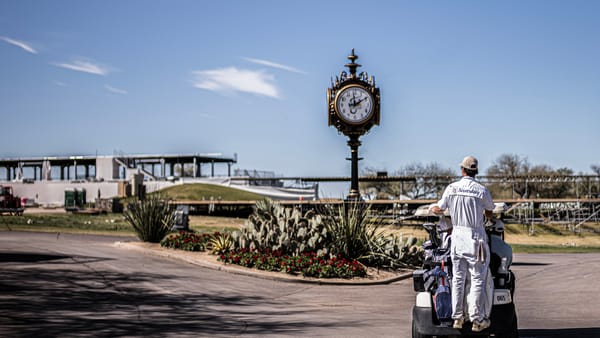
The WM Phoenix Open calls itself The Greatest Show on Turf.
From the outside, that sounds like marketing.
From the inside, it’s something else entirely.
Noise. Movement. Booing. Cheers. Energy that never settles. Players walking into an environment that feels closer to a WWE entrance than a traditional golf tournament.
For fans, it’s a party.
For players, it’s a stress test.
Pressure isn’t rare
You just notice it more in Phoenix
Most golfers think pressure is something that only exists on Tour.
It isn’t.
It shows up standing over a four-foot putt to shoot your lowest score ever.
It shows up when you know par-par breaks 80.
It shows up on the tee in a scramble when the three players ahead of you didn’t put a ball in play.
It shows up the moment your friends stop talking and start watching.
Different stakes. Same nervous system.
The Phoenix Open doesn’t introduce pressure.
It just removes the illusion that pressure is optional.
What pressure actually does
Under pressure, time compresses.
Heart rate rises. Attention narrows. The brain stops analyzing and starts protecting. There’s no room for complex swing thoughts or detailed mechanical checklists.
This is where most golfers discover an uncomfortable truth.
You don’t rise to your technique under pressure.
You fall back to your capacity.
What your body can support.
What your nervous system trusts.
What you’ve actually reinforced.
The 16th hole doesn’t forgive anything
The most honest place in professional golf might be the walk through the tunnel to the 16th tee at TPC Scottsdale.
It’s loud. It’s chaotic. It’s electric.
And once you step out, there’s nowhere to hide.
This isn’t a place for frustration or control. Players who react to noise, argue with the crowd, or try to fight the environment don’t last long there.
You can’t quiet the Phoenix Open.
You can only quiet yourself.
That’s why the 16th hole is such a revealing test. It strips away anything that isn’t stable. What remains isn’t a swing position. It’s the system underneath it.
Why swings break when the noise rises
When pressure exceeds capacity, compensation isn’t optional. It’s automatic.
Not because the player panicked.
Not because they forgot what to do.
But because the system is protecting itself.
This is why unsupported mechanics collapse under stress.
This is why “range swings” disappear on the course.
This is why golfers feel like they lose control exactly when it matters most.
Pressure doesn’t create the problem.
It exposes it.
This is where anchors matter
When chaos rises, complexity becomes the enemy.
The players who survive environments like Phoenix aren’t thinking about mechanics. They’re anchored.
One thought.
One intention.
One simple cue that quiets the noise.
That anchor doesn’t fix the swing.
It gives the system something stable to organize around.
This is true on the 16th tee in front of 20,000 people.
And it’s true standing over a four-foot putt on a Saturday morning.
When attention disappears, whatever remains is what you’ve actually trained.
Real skill isn’t loud
The irony of The Greatest Show on Turf is that it exposes how quiet real skill actually is.
The most durable players don’t look rushed.
They don’t fight the environment.
They don’t try to control everything.
Their swings may not be perfect.
But they hold up.
That isn’t aesthetics.
That’s capacity.
The takeaway
The Phoenix Open doesn’t reward perfect swings.
It rewards swings that can survive noise, speed, adrenaline, and disruption without falling apart.
That’s true on the 16th hole in Phoenix.
And it’s true when you’re trying to close out the best round of your life.
Pressure always reveals what’s real.
And real improvement isn’t about what looks good in calm conditions.
It’s about what remains when calm conditions disappear.
Where this goes next
Understanding pressure is one thing.
Training for it is another.
The next question isn’t why swings break under stress.
It’s why reinforcement, constraints, and repetition matter more than awareness when pressure shows up.
That’s the next layer.