Breakfast Ball
Range felt like I had it. First tee said I didn’t. TPC Scottsdale, a breakfast ball, and the part nobody talks about—the searching, not the bad shot.
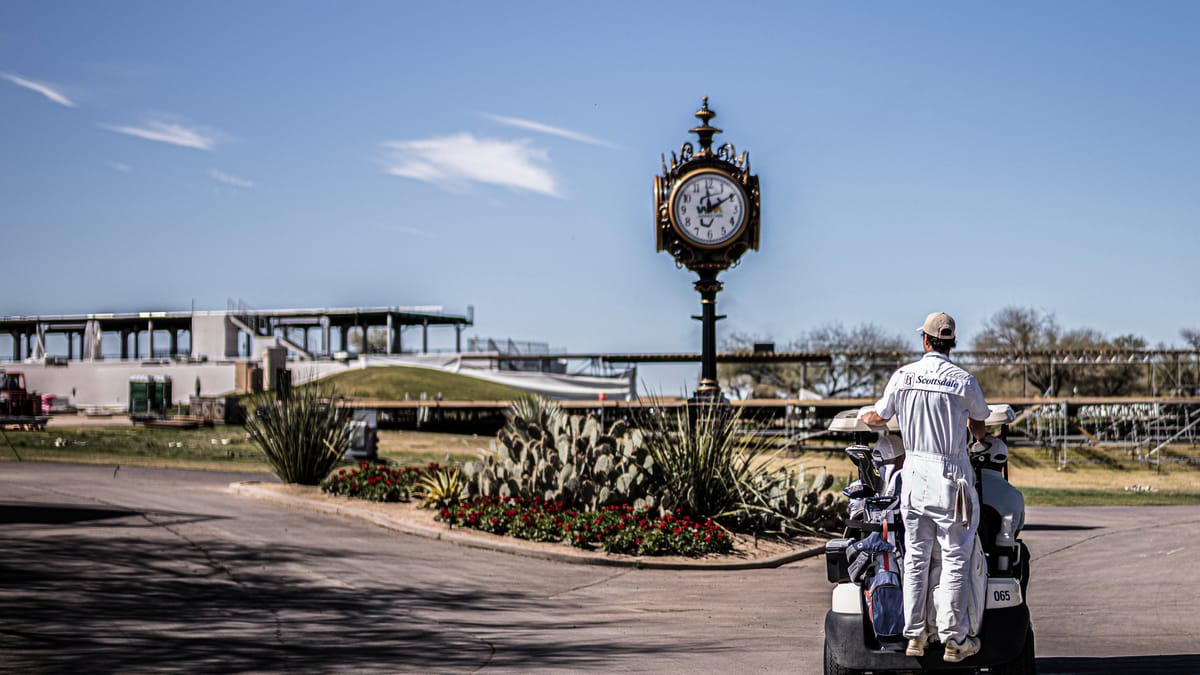
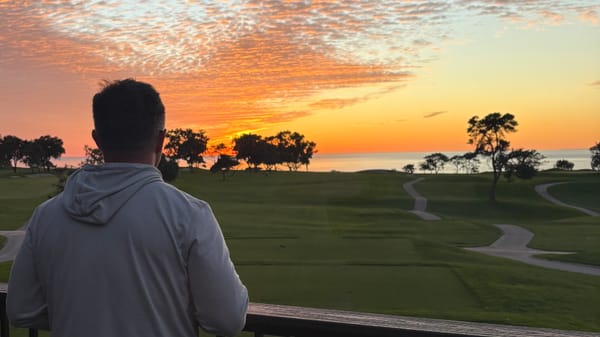
I played TPC Scottsdale a couple weeks after the Phoenix Open.
The grandstands were still up. The skyboxes around 16. The walkways where twenty thousand fans had been standing not long ago, drinking beer and booing three-foot putts. All of it still there. Empty now. Quiet.
The greens were still fast. The course was in amazing shape.
Different tournament.
Same course.
My friend Tim was coming out from back east on a guys' trip with Garrick and JP — friends from the Army Navy Club outside of DC. He told me they were heading to Arizona and asked for course recommendations.
I asked if I could join for a round.
Their fourth had to take the red-eye home the night before, so Tim said yes. Their fifth round of the weekend. I was grateful he asked.
I hadn't seen Tim in a couple years. I don't think I'd golfed with him since high school. A great friend. The kind of guy you pick up right where you left off with, no matter how long it's been.
Garrick is a doctor. JP is a consultant.
None of that matters.
On the course, JP was the guy with the smooth tempo who kept piping drives right down the fairway. Garrick was the fun one — affable, easy to be around, the let's-get-another-Banquet-beer-and-enjoy-the-boys kind of guy. They let you into inside jokes from the Army Navy Club before you'd even finished the front nine.
They were just good guys. We talked about everything. Life. Kids. Sports. Work. Nothing.
Somewhere around the turn, we caught the overtime gold medal game on someone's phone. Jack Hughes burying the game winner. USA shattering the hopes and dreams of all Canadians.
Nothing like a little USA, USA, USA between the boys on a Tuesday morning.
The kind of round where four hours disappears and you wonder where it went.
I was grateful. Grateful Tim asked. Grateful they let me in.
I got to the range early.
I'd been struggling with my driver for weeks. The kind of stretch where you don't trust it, don't want to pull it out of the bag, and start thinking maybe you should just hit three-wood off every tee for the rest of your life.
But that morning, something clicked.
I was piping drives down the range. Center of the face. The ball was jumping. The flight was straight. One after another. The kind of range session where the confidence just starts building on itself and you think —
This could be the round.
I felt good. I felt ready. I walked to the first tee feeling like I had something.
And then I topped it.
First swing. First hole. TPC Scottsdale. The grandstands right there.
Hard left. Into the bushes.
I looked at Tim. He looked at me.
Breakfast ball.
There's nothing quite like the gap between the range and the first tee.
Every golfer has felt it. You leave the range feeling like you figured something out. You walk to the tee box carrying that confidence like it's yours to keep. And then the first real swing — the one that counts, the one with people watching — reveals that what you had wasn't what you thought it was.
The feel that was right there five minutes ago is gone. And now you're standing in front of your friend — a friend you haven't played with since high school — searching for it.
That's the part nobody talks about.
Not the topped drive. Not the breakfast ball. Not the bad shot itself.
The searching.
When it goes wrong on the first tee, the brain starts racing. What was I doing on the range? Was it the takeaway? The tempo? The weight shift? Was it something with my grip?
Every swing thought you've ever had shows up at once. They don't help. They compete. And now instead of swinging, you're thinking. Instead of executing, you're debugging.
The range gave you one feel. The first tee gave you ten thoughts.
That's not nerves.
That's overload.
The shots that worked — the ones that felt clean and traveled the way I wanted — all had one thing in common.
I wasn't thinking about my swing.
I had found one cue. One feel. A single connection point between what I'd practiced and what my body needed to do in that moment. When I locked into that cue, everything else went quiet. The swing organized itself.
When I lost that cue — when I went searching for it, or worse, started stacking swing thoughts on top of each other trying to get it back — the wheels came off again.
One thought, and I could play.
Five thoughts, and I was back in the bushes.
I've thought about this since.
Not as a golfer replaying a round. As someone who has spent the last year studying how improvement actually works.
The range session wasn't fake. The driver was actually working. The feel was real. But the feel was fragile. It existed in controlled conditions — same mat, same target, no stakes, no one watching. The moment the conditions changed — real tee box, real consequences, Tim standing right there — the feel required me to go find it.
And that search is where it breaks.
When you have to consciously locate the thing that makes your swing work, you're not executing. You're solving. And solving under pressure is a losing game. The brain doesn't solve well when the heart rate is up and attention is narrowing and you're standing over a ball that suddenly feels very small.
The golfers who don't lose it on the first tee aren't smarter. They aren't calmer. They aren't more talented.
They've reinforced the pattern deeply enough that they don't have to search for it.
The feel is already there. Automatic. Below conscious control. Available without asking.
That's the difference.
Not what you know. What you own.
Owning vs. searching.
I wrote a few weeks ago about the Phoenix Open. About how pressure doesn't create problems — it exposes them. About how you don't rise to your technique under pressure. You fall back to your capacity.
I wrote that from the outside. Watching pros. Analyzing what holds up under noise.
Then I walked onto the same course. Stood on the same tee boxes. With the same grandstands casting shadows across the fairways.
And I topped my first drive into the bushes.
Pressure didn't create a new problem for me.
It showed me exactly how deep — or how shallow — my improvement actually was.
The range told me I understood my swing.
The first tee told me I hadn't reinforced it.
Those are not the same thing.
And that gap — between understanding and owning, between the range and the course, between the feel you had and the feel you couldn't find — is where most golfers quietly lose the progress they thought they'd made.
Not because they practiced wrong. Not because the tip was bad. Not because they don't have the talent.
Because the feel was real but it wasn't reinforced. And unreinforced feels don't survive the walk from the range to the first tee.
Tim didn't care that I topped the first one. Garrick and JP didn't blink. Nobody ever does. Golfers understand.
But I cared.
Not because of the score. Not because of the leaderboard that didn't exist.
Because Tim is a great friend. And I wanted to show him something worth watching. I wanted to play well in front of someone who matters to me. I wanted the version of my game that showed up on the range to be the version that showed up on the course.
That's ego. The quiet kind. The kind nobody posts about.
And golf exposes it every single time.
I'm grateful Tim let me into their round.
I'm grateful Garrick and JP let me into their jokes and their afternoon.
I wish I could have played better.
But maybe that's the point.
The gap between the range and the course isn't something you think your way across. It's something you earn your way across. More reps of the right thing. More time with the one cue that works until it stops being something you have to find and starts being something you already have.
I'm not there yet.
But I know what the gap is now.
And that might be the first real thing I've learned about my own game in a long time.